
HOME     INDEPENDENT TRAVELLERS     ESCORTED TOURS     TAILORMADE GROUPS     TRAVEL WRITING     NEWS & EVENTS     ENQUIRIES     ABOUT US 
NEW FESTIVAL TOURS
INDEPENDENT TRAVELLERS
Great Faiths of India
Hindu and Christian in...
Mahatma Gandhi...
South Indian Temples and...
The Soul of Sikhism
The Source of Yoga
Kolkata and East India
Holy Amarnath Cave
In Footsteps of Buddha
Jainism and Jain Shrines
The Source of Ganges

» Travel Writing

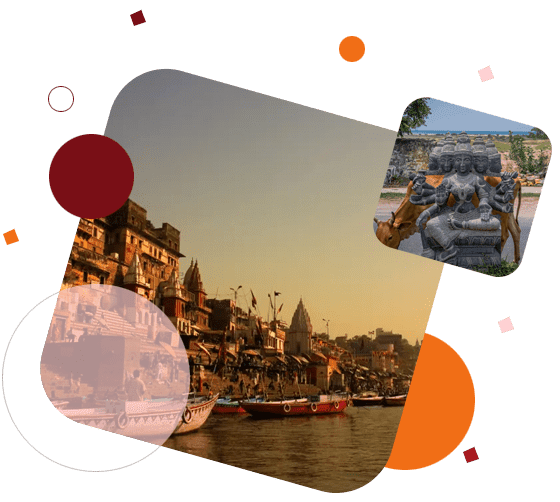
Varanasi — City of Lord Shiva

Varanasi is the city of death. The life-giving river Ganges, flowing past the Eastern edge of the city, here bears life away. At Varanasi, the sacred river is halfway from its birth in the Himalayan abode of the gods, to its absorption in the Bay of Bengal. And this is the place to come and die.

The smell of death hangs over the city. Beside the new and unused civic crematorium, the funeral pyres burn continuously on the open bank of the river. Here in Varanasi, it is said, you can have immediate release from the cycle of birth and rebirth. Without passing Go, the soul proceeds directly to its moksha, its liberation.

From all over India eldest sons come to Varanasi, bearing the ashes of their parents, to scatter them on the great river. For not everyone has the prescience to reach Varanasi before they pass away, and having your ashes scattered on the Ganges at this holy point is the next best thing.

In many cultures sex and death go hand in hand, and nowhere more so than in Varanasi. This is the city of Lord Shiva, known as the Destroyer, whose symbol is the unmistakably phallic lingam. The funeral pyres symbolise Shivas dance of destruction, leaping flames copying the frenzied ecstasy which releases the soul.

Nearly two tons of beaten gold cover the dome of Lord Shivas temple, called Vishwanath, in the old city. In the dark womb of its interior, beneath enormous bells, stands the simple black lingam, adorned with flowers, and gleaming with the milk and honey poured over it.

And here, on the great night of Lord Shiva, when he is married to the goddess Parvati, the earth is shaken to its core, as the holy couple re-make the universe.

Mahashivratri, as that night is called, is the night for love-making. Couples should remain at home, and with all necessary adornments re-live their first night of conjugality. Only the young men, waiting for their marriages to be arranged, are on the streets. In their tens of thousands they come, to sublimate their virility in the ferocious religious drama of the night.

I followed the crowd that night. A mile from the temple it was already thick. A wind band, screeching and tuneless, hacked its way through, and allowed us to follow. Almost naked sadhus, smeared with ghostly ash, lunged at us out of the crowd. Spotting foreigners, they opened their straw baskets and waved cobras under our noses, until they were satisfied with our donations.

As we neared the temple, we entered the realms of barbed wire and armed troops, for like its better known cousin, Ayodhya, Varanasi is also sometimes the focus of Hindu-Muslim tension. Narrow barriers kept us controlled beneath high fences and barbed wire. The atmosphere is tense. The crowd is dense and hot, and religious fervour is heightened by drink and sweet smelling drugs. "Hari! Hari! Bom! Bom! Hari! Hari! Bom! Bom!" The chant increases in intensity as we approach the temples entrance.

It is a dangerous night to be out. Only the flower sellers and the troops are unmoved. Suddenly, at almost the magic midnight hour, we round a final corner, and surge towards the temple entrance. Religious frenzy boils in the fetid atmosphere. Young priests, naked to the waist, and streaked with red powder paint, take it in turn to restrain the faithful from throwing themselves onto the image of Lord Shiva. Others shovel the thrown flowers out into the drain.

The crowd behind keep us moving. Darshan is no quiet contemplation here, but a struggle to catch a glimpse of the holy image, and a struggle to breathe.

And that was it. Pushed unceremoniously outside again, nowhere near where we had come in, we woke up lost, but at least in a known world once more. We hurried barefoot through the alleys, slipping through cow dung, and bumping into sacred animals and soldiers smoking. Two men rounding a corner with a saffron wrapped body on their shoulders nearly knocked us over.

Half a night later, being rowed gently along the glassy Ganges at dawn, we surveyed Varanasis teeming river bank. Surya, the sun god, rose silently behind the far bank, and acknowledged the thousands of bathing worshippers. Lord Shiva, exhausted from the primal work of procreation, slept, and a new and re-ordered world came miraculously into being.

© Kenneth Wilson

 Orange Dust : Journeys After The Buddha
 
Reservations - please call 020 8901 7630 | Email @ enquiries | Enquiry Form
Soul of India Tours is operated by Indus Tours and Travel Ltd.
© Soul of India 1999 - 2012 | KBC Harrow Exchange | 2 Gayton Road | Harrow | Middlesex HA1 2XU | UK
Our ATOL Number is 4586 Our ABTA number is W5240 Know Before You Go