

Soul of India - Spiritual Journeys, Group Holidays & Travel in India

travel writing


Sevagram – Staying with Gandhi


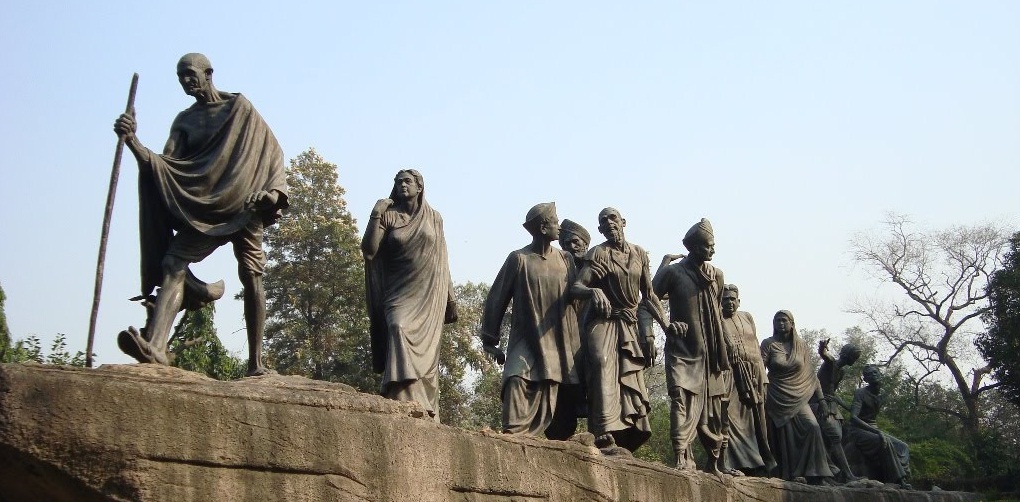
Mahatma Gandhi lived a life of paradox. Grand passions lived
alongside obsessive interest in the minutiae of daily life.
Gandhi could be as interested in his bowel movements as he
was in the juggernaut of India Independence.

He chose an unknown village outside an unknown town in
middle India to locate his "retirement" ashram. The choice
itself was founded on paradox. He wanted, he said, to be at
the heart of the country. That meant living in one of
India's 300,000 villages, in the interior, away from the
polluting influence of metalled roads. He wanted to be close
to the axis of North, South, East and West, equally
accessible from every point of the compass. So he chose
Wardha, a major railway junction, equidistant from India's
four metropolises, Delhi, Bombay, Calcutta and Madras.

Gandhi came here in 1934, when he was already 65. The ashram
began to be carved out of the snake infested wilderness two
years later.

For a few years the tiny settlement, renamed Sevagram,
"village of service", became India's second capital.
Courtesy of His Majesty's Imperial Government a telephone
was installed at great expense, and a dedicated Post Office
opened. Sitting on the mud floor of his hut, Gandhi dictated
terms to his country's leaders, and continued his masterly
provocation of the British.

Sevagram is now part museum, part Utopia. It is still a
living ashram, to which a few strange souls make the journey
once made by Viceroys. Its inhabitants are living history,
praying daily before dawn the prayers Gandhi taught them,
and spinning their own khadi in the shade of Gandhi's own
verandah.

Most of them are of an age that they might have known him.
Several of them claim to have done. They marched with him,
and kept his message alive while he was in prison. To the
smartly dressed Indian day tripper, their life seems dreary
beyond comprehension. But they have never lost the
inspiration and the idealism which brought them under
Gandhi's spell in the first place.

And we, a few foreigners sharing the spartan rooms first
built for visitors forty years ago, are coming under that
spell too.

Not many of us are accustomed to rising at 4.30, to sit on
the cold ground and chant our prayers. But we do it, if only
to be polite. We eat plainly, and talk about changing the
world. We sit under the tree Gandhi himself planted, or walk
barefooted and reverential through the bamboo and mud huts
where Gandhi's ghosts are to be found.

Here are all his possessions, a mat and a massage table, a
cot and a writing desk - half height, for sitting on the
floor. There are his spinning things, and those famous three
monkeys, "Hear no evil, see no evil, speak no evil". In the
afternoon an old lady comes quietly into this hut, and
begins her rhythmic, faraway spinning. In another hut, next
to the telephone in its tardis, is a pair of long-handled
teak tongs, and a narrow teak box - for catching the ashram
snakes and returning them to the jungle.

There is another visitor in the ashram, an urbane and
educated Bombay dweller, an 80 year old refugee from the
Partition. Clad in homespun cotton, he goes shoeless, as he
has done every day for fifty years, in fulfilment of a truly
Gandhian vow. Nehru, he said, should visit his village to
see how the people suffered. Until that day he would walk
barefoot. Nehru never came.

This man will accompany us on a journey to another great
ashram nearby, founded and named after Vinobha Bhave. Gandhi
had many disciples, but none greater than Vinobha Bhave, who
travelled the country from end to end calling on landowners
to redistribute their acres to the poor. Vinobha's
exhortation became a great movement, and millions of acres
were given away. Some, of course, was worthless land, and
some of it gradually migrated back to its original owners,
but overall it may have had more effect than Mrs. Gandhi's
later confiscation of the royal landed estates.

Vinobha's ashram is built on the bank of a stony river.
Here, after his assassination in 1948, a portion of Gandhi's
ashes was scattered. Every year there is a solemn gathering
of worthy pandits, homespun cotton is symbolically offered
over the river, and a hundred thousand villagers have a
fair.

After the fair, we spoke to the head of Vinobha's ashram, a
small woman in orange. The ashram was founded on a most
auspicious spot, where ancient religious images were later
found buried. This, she said, was a divine endorsement of
Vinobha and his message. Now the ashram community are mostly
women, who practise a peculiarly labour intensive form of
self sufficiency. Every hour of work is recorded, and each
gram of produce weighed, so that you should always know how
much work was represented by what you ate today.

We returned, along poor and dusty roads, to our Gandhi
ashram. We slept, crowded, on the hardest of beds, as the
mice ran underneath. And we pondered this peculiarly Indian
institution, the ashram.

Literally, an ashram is nothing more than a place to live.
But since, in Hindu thought, the place and style in which
you live is connected with the spiritual stages of life,
there is a spiritual connotation to the word ashram. It has
come to mean a place where there is some spiritual or
visionary impetus behind the rule of life. Some ashrams are
communal, some are solitary, but they all bind up into
themselves something of the Indian tradition of the search
and fulfilment of destiny.

In theory anyone is welcome in an ashram. Westerners seeking
their freedom through wandering and the abandonment of
rules, have made some ashrams suspicious. But for us, a few
days spent in the womb of Sevagram ashram was a deep
experience. It brought some of the most important twentieth
century history to life. More than that, it brought
something to life deep within each of us - something about
inspiration and, perhaps even, destiny. © Kenneth Wilson

back to travel writing


Soul of India tours are operated by Indus Tours and Travel under ATOL 4586

© Soul of India 1999